Featured

“What is Academic Writing?”

Summary:

Academic writing is essentially writing with purpose, integrity, and in a compelling way. It is less about format (not that format isn’t important) like it was in high school and more about effective argument. When given a writing prompt it is crucial that you gather the necessary knowledge to execute your argument in a convincing way. This means knowing how to find good, reliable sources whether that be in a library or online. When you are picking a thesis you need to make sure you haven’t bite off more than you can chew. If you intend to write a three page paper you need to choose a thesis that is narrow enough to be fully and successfully covered in that length of writing. It is also important to prove your claims with evidence and not be too emotionally driven in your essay. Don’t be too opinionated without backing up that opinion with facts. Finally, it is important to constantly have an idea of what you want your audience to take away from your essay while you are writing it. 

Response: 

The main point of “What is Academic Writing?” was to differentiate high school essay writing from college essay writing. It made me realize that in college my research behind a paper is just as important as the writing itself. If I don’t know what I’m talking about I am not going to write a compelling argument. I don’t feel that I got a clear definition of academic writing; I interpreted it as more of a style (an advanced way of writing). This raises the question, is there a straightforward definition? I also felt that the styles of writing the article was recommending wasn’t much different from the way I was taught to write in high school. Is this because I took honors and accelerated English courses or did I not fully understand what the article was trying to teach me?

Something I disagreed with in the article was that it is better to get your sources from books rather than the internet. Did is recommend this because it is an older article or is there something I’m missing? I feel that you can find professional sources on the internet just as well as in books if you know where to look. 

Overall, I found the article helpful and informative. I look forward to exploring the strategies of writing it recommending over my English 130W course.
Argumentative Essay Proposal

 I would like to write my argumentative paper on how a person’s diet influences and can contribute to the decline of the environment and the atmosphere. I will focus on two major contributing factors to do so: overconsumption of meat and dairy & eating locally grown, in season fruits and vegetables. I am also considering discussing the health benefits of these practices as well depending on how much information I can find on the environmental destruction.

I took advanced placement environmental studies my senior year of high school and I am a vegetarian (I was vegan for a year and still try to eat as close to vegan as possible while eating in the dining hall) so I believe I have both the knowledge and the passion for this topic. Something like 70 percent of the United States soil is used for agriculture and 45 percent is used specifically for cow which produce high amounts of methane both during their lives and in the production of milk and beef. People like to argue that you need 10 gallons of water to produce one almond, but almond milk still uses 23 percent less water than dairy milk. These are just a few statistics that I know off the top of my head. 

I have began looking at articles on the Meriam Library website and plan to dig up some of my old, shorter papers for high school that I wrote on similar topics to look as the sources I used then. 

Corporation Blog Post

Birkenstock claims that their shoes are made from sustainable resources, but I have always wondered how sustainable leather can be? On their website they explain that their cork is naturally regenerative at the rate in which it is harvested. They also proudly display on the page in bold letters that “98% of their adhesives are water based and therefore environmentally friendly.” I find it interesting that they do not mention striving to be 100% water-based. Companies often like to take the easy way out when it comes to environmental practices and never work to continue to decrease their impact. They also mention in their first paragraph that their leather is sustainable but never mention how they manage to do so. They have only recently (in the last five years) began to even offer vegan leather straps on their sandals. The beef industry is far from sustainable, so how is Birkenstock an exception? 

On the flip side I found it impressive that they use a natural latex that is harvested from rubber trees and is both free of chemicals, such as CFCs and pollutants, and better for protecting the cork on their sandals. They mentioned that one “rubber tree will provide about 80 grams of latex each and every day for 25 years.” 

Birkenstock has been around since 1774. In their mission statement they claim that they are “always looking to improve their footwear,” however they haven’t changed their product hardly at all since the company was developed. They do however have excellent employee benefits and treatment all around the world, especially in Germany. 

As far as marketing goes, Birkenstock has come in and out of style over the years but has consistently been the “pretty ugly” shoes. They appeal to multiple different ages and sexes, making it easy for they to market to a large demographic. They currently mainly advertise on social media apps such as Instagram. 

Birkenstock has partnered with organizations such as “Soles4Souls” and those similar to donate shoes to those in need around the world. 

In an article by the New York Times, “The Nation: Footwear Politics; Just Who, Really, Is a Birkenstock Voter?” Birkenstock is described as a “liberal’s shoe,” simply because the sandal tends to be worn by those who lean to the left. The article also depicts the lifestyle of those who are Birkenstock fans. They tend to be democratic, adventurous, and “are the type to get away for the weekend by going skiing in Colorado.” This article made me wonder how and why certain fashion choices tend to be adopted by certain types of people. Is it “following the crowd” or something deeper? 

In conclusion, I believe Birkenstock is a better company than most but there is always room for improvement. I hope that they continue to grow as a brand. I do not buy Birkenstocks anymore because I like to fix what I already have. You can  purchase new cork and rubber soles online and how someone repair them at a shoe repair store. I hope Birkenstock starts doing this for their customers so everyone has the option to be more sustainable.

Rhetorical Meme

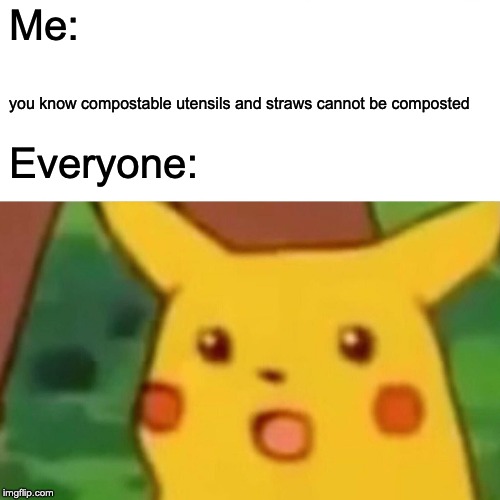
This meme is meant to explain that compostable plastic cannot be composted, despite what the packaging says. It can only be composted when exposed to air. I used to work in a restaurant where we had to go through the trash and pick out the “compostable” utensils from the compost. Most of them cannot even be recycled. When you put compostable plastic in the green bin it is buried underground and cannot compost the way it was intended.

Sarcasm is used in this meme in order to get the message around. It is kind of made to make the average person, who may not know that the compostable plastic isn’t compostable, like they are not educated. This may give me, the creator, some more credibility.

I also used the rhetorical strategy pathos. It may make some people feel badly that they are using “compostable” plastic products that are, in fact, not compostable. They may feel like they are not doing their part for the environment. This may makes them steer away from the products all together, like I intended when making the meme.

This meme doesn’t really use logos, however it does seem logical that plastic, whether it says it is “compostable” or “biodegradable”, would not be able to do either of those things.

In conclusion, rhetoric is everywhere, even in the memes we scroll through on Instagram. We are constantly under an intended influence. If you understand how to use rhetoric, you can better understand how and why it is being on you.

10/2 Class Participation Discussion Questions

  1.  What have you taken away/ what can you tell me about Rhetoric? 

From writing a rhetorical analysis I have discovered that rhetoric is truly involved in everything we do and everything we are exposed to. It is not just in advertising and tv commercials; in fact we may use ethos, pathos, and logos unknowingly in our everyday conversations and interacts. By understanding what the rhetorical flourishes are you can better understand when and why they are being used on you.  

2.   How does rhetoric relate to critical thinking/reading? 

When looking for rhetoric in an article you need to evaluate the text at a deeper level, forcing you to think critically and to read with purpose. You are not just reading the article or story; you are also reading the intentions of the author behind the text. 

“Are You Arrestable?”

The Cleanest Line

This article follows a woman, Sarah Hartigan, environmental activist, peaceful protest training with a program called Extinction Rebellion in Studio City, California. When signing up she was asked if she was willing to be arrested; she answered “yes”. 

From this article I learned you can be arrested and face serious punishment in some cases, just for “civil disobedience” and that even touching a police officer can be considered “battery”. The article also expressed your power in remaining silent when being arrested. 

I believe the main point of this piece was to educate the public on the importance of safe and legal vs illegal protesting habits in the age of environmental activism. 

The article reminded me of walk-outs in high school. We had some for gun violence and some for environmental activism. If you walked out you would get written up for ditching class and it would go on your transcripts. People had to decide if they felt the cause was worth fighting for, like how Hartigan had to decide if protesting was worth getting arrested for. I can admit I was willing to take a “cut” on my transcripts. I’m not sure if I am brave enough to take an “arrest” on my record. I admire those who can more than anyone.

September 18-20, 2019 In Class Work

18 September 2019

Rhetorical Situation

  1. My little sister watches a lot of different youtubers and they will talk about how you can be part of their “family” and you can help them by purchasing their merchandise. It is very manipulative because they know that young children are watching their videos and they often make them feel like if they don’t own merchandise they aren’t a true fan of the youtuber’s channel. They are kinda applying to the pathos of the children by trying to make them feel like they are a part of something. 
  2. Pathos works best when you want someone to understand what it feels like to be in another person’s shoes or when you want sympathy. 

20 September 2019

“Backpacks vs Briefcases” Close Read

(Column 4, paragraphs 4-6)

  • Pathos is “persuading our hearts”
  • PETA example: baby chick next to Ronald McDonald with a knife to showcase animal cruelty 
  • When pathos is used alongside ethos and logos it can make it more effective
  • Pathos is the most effective form of persuasion when you have to do so in a short period of time; this is why it is often used in tv commercials/advertisements 
  • Pathos holds an audience’s attention for longer than ethos and logos in most cases

“Backpacks VS Briefcases”

The main point of “Backpacks vs Briefcases” was to introduce rhetoric, explain its significance, and explain the ways in which we are persuaded (ethos, logos, pathos). I took a rhetoric heavy English class my senior year of high school so digesting this article was relatively easy for me to do. However, there were some things that were expanded upon or new to me in the text. It was interesting to learn that rhetoric is truly in everything, not just persuasive writing and advertising. It was also interesting to learn that we use rhetoric even when we aren’t intending to. Considering the fact that I want to go into the marketing and advertising field when I graduate I found the information both interesting and significant. 

This article is related to what we discussed in class because we about to more into a rhetoric heavy unit, which I am very excited for. This article was a really good way to begin this topic, but there were a few parts that were difficult to fully absorb from reading it just once. I think it will be helpful to read it a second time and do a close read like we will be doing during the next class period.

National Geographic: “Geography”

When reading this piece on the history of geography it reminded me of an article I read for my anthropology 111 class about the history of anthropology and how it came to be. In a way I think that the way in which people approach studying the earth and its history is very similar to the way Anthropologists study humans. 

I also found that this piece will help me approach my environmental narrative. It made me consider how environment/geography interact with humans in a more literal sense. 

I found it very interesting that map making and other geographic advancements mainly started in the Middle East and Asia. I feel when I think about exploring the geography of the planet I often picture European explorers, so this fact caught me by surprise. It also made me wonder why I wasn’t taught about Middle Eastern and Asian (and specifically within the Chinese Empire) exploration. 

It was interesting to learn that maps are constantly getting more and more advanced– even recently. I never really considered how much satellites and documentation influenced this practice. 

In conclusion I found that the science of geography is really related to all fields of science. You can’t really have one without the other. It helps us study medical science, anthropology, marine biology, paleontology, space, environmental studies, and even political science in a way. This article helped me realize we are more affected by our planet and our environment than we may have originally thought.

The Cleanest Line: “A Measure of Hope”

When I first started reading this article I was depressed. I already know all the wrong we have done as humans and how we have hardly any time to fix it. However, I soon realized that I was going to get a solution– I always find this uplifting– even though I already do more than most when it comes to being environmentally conscious. 

A question that was raised for me was what are wildlife corridors? It was never really explained so i went to do my own research. I learned that it is like a protected area that humans need to leave untouched. I had never heard this described as a “corridor” before, but of course I love the idea. I found that the proposal of Wildlife Corridor Conservation Act of 2019 to be the “hot spot” of the piece. 

This article reminded me of class because we were told that their would be a focus on environmental concepts throughout the year. I am now more excited than ever to begin reading “Let My People Go Surfing” later this month. 

Overall, this article left me feeling hopeful for the future of our planet– something I wasn’t expecting in the beginning. It is encouraging to be reminded that while we are the reason for the harm of Earth and its inhabitants, we can also be the saviors if we work quickly and efficiently. This raises another question. Will we buckle down and sacrifice our comfort and materialistic lifestyles to do it?

Design a site like this with WordPress.com
Get started